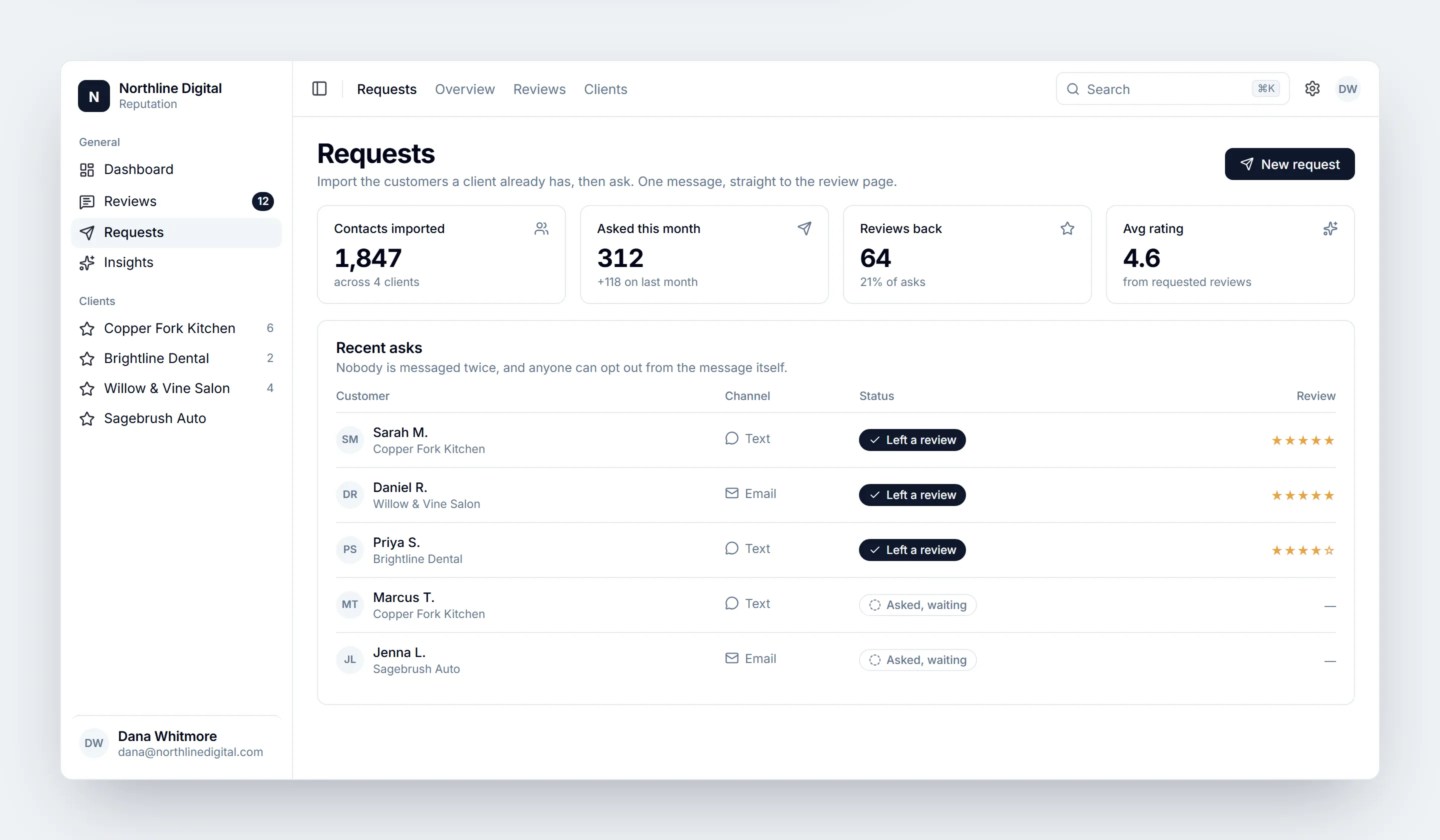
Contacts, per client
One account holds every business you look after, and each one holds the customers it already has. Import a spreadsheet or a booking export, and move between clients without signing in and out.
AI reputation management for agencies
An AI that requests reviews, reads the sentiment in them and writes every reply — packaged into your local SEO and ad retainers, under your own brand, at your own price, without adding headcount.
Book a slot
Pick a time that suits you. We take on partners a few at a time.
Choose a time →Would rather type than book? Message us.
The problem
Reputation is the service every agency knows it should offer and almost none do. Not because clients would not pay — because of what it costs you to deliver.
Every client has a listing collecting reviews nobody answers. You know it matters. It has never been worth building a team around.
Tools get bought, onboarded, and quietly abandoned when the person who championed them is busy. Anything that needs daily attention will not survive contact with a real week.
Rankings move slowly, ad spend is someone else's number, and the client asks what they are paying for. You need something that visibly happened.
Sending clients to a tool with another company's logo on it makes you the middleman. The next renewal conversation happens without you.
What you get
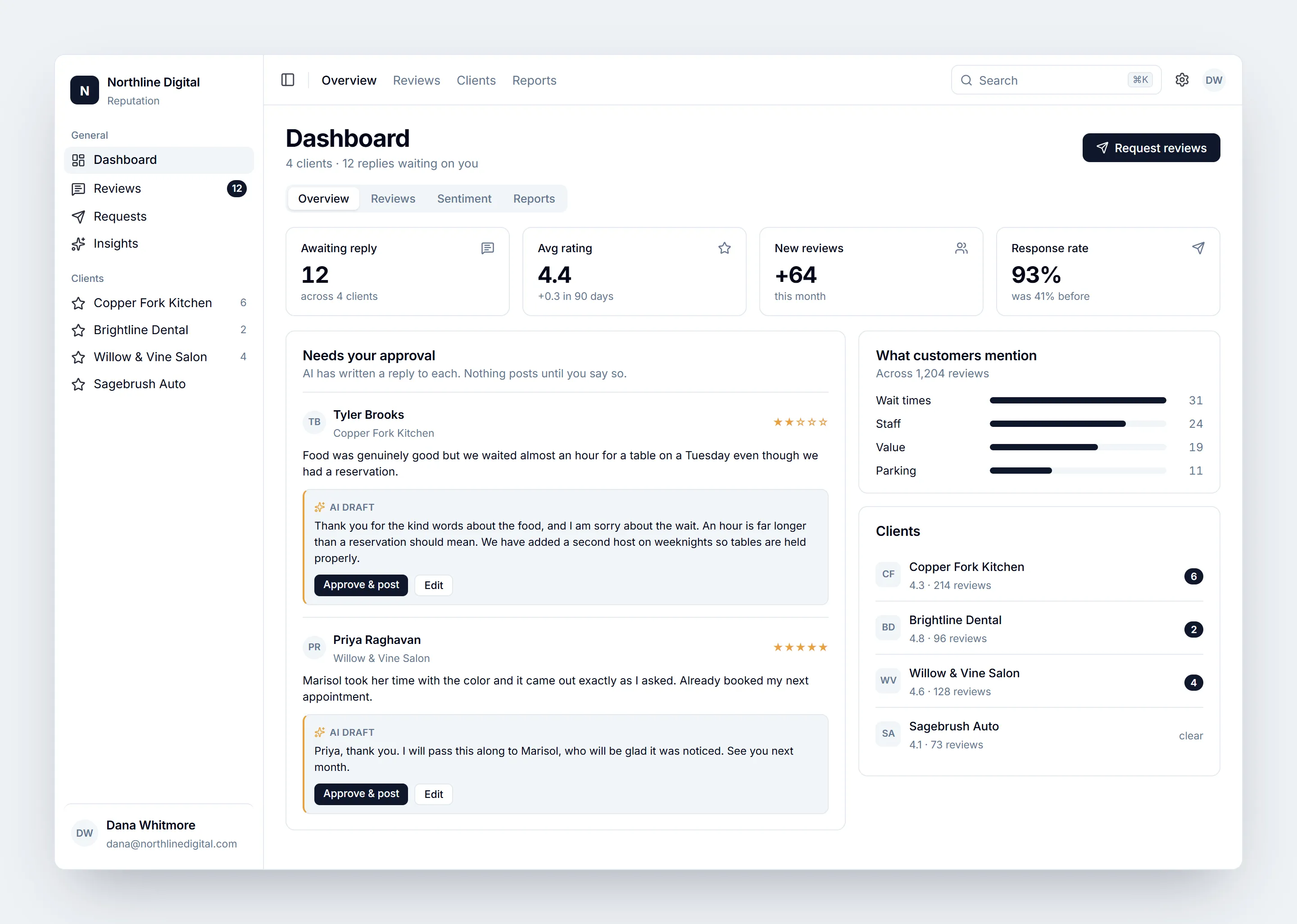
One account holds every business you look after, and the AI has already done the reading: reviews collected, sentiment sorted, a reply drafted under each one. A week of reviews becomes a pass down a list rather than a round of logins.

One account holds every business you look after, and each one holds the customers it already has. Import a spreadsheet or a booking export, and move between clients without signing in and out.
An AI draft waits under each review, written for that review and no other. Approve them yourself once the owner has authorised you, leave approval with the owner, or let routine replies post automatically, which Google permits only with the owner's specific and express consent.
Rating over time, response rate, and what customers keep repeating, per client and across the roster. That is the monthly slide you were going to build by hand.
One message to a client's customer list that opens their Google review page. Everyone is asked the same way, nobody is asked twice, and anyone can opt out from the message itself.
A snippet that puts a client's real reviews on their own pages, styled to their brand. One line of HTML for whoever looks after the site.
A short score-and-comment survey that stays between the customer and the owner — where “the 4pm slot always runs late” surfaces while it is still fixable, rather than in public.
Getting reviews
Not because they were unhappy, because nobody asked. Import the customer list your client already has and send one message that lands on their Google review page. Nobody is asked twice, and anyone can opt out from the message itself.

White-label
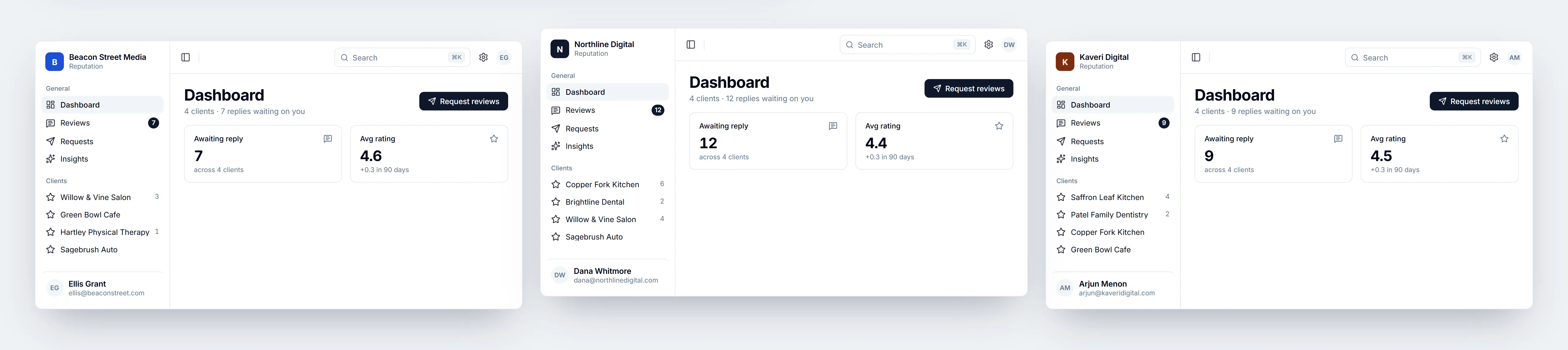
Your logo on the dashboard, your name on the login, your name again on the line where every other tool credits itself. The moment a client sees a third party's branding, they know who to renew with directly, and it is not you.*
* One exception, during setup only: Google's own consent screen names VouchMyBiz when the owner grants access. It appears once, and nobody can rebrand it.

Getting started
One agency login, however many clients sit under it. We set it up with you on a call — there is no self-serve signup to fight with.
The business owner signs in with Google and authorises access. That step is theirs to take: Google requires every end user to sign in manually, so nobody can be added in bulk. It takes about a minute.
Every review that lands gets an AI-written reply waiting under it, written for that review rather than from a template. By default nothing posts until someone approves it, and the owner decides who that someone is: you, or them. They set that per client when they grant access.
What you can hold us to
You would be putting your name on this, so “why should I risk it” deserves a straight answer. These are not promises we could quietly drop: they are how the product is built, and they are the terms any serious provider in this market works under.
Access is theirs to give and theirs to withdraw. They ask, and we release it inside a week. A client who leaves you keeps their profile exactly as it stands — nothing about their listing depends on them staying on your roster.
The owner agrees in writing before anything is posted for them, and we keep that record so nobody is reconstructing the conversation a year later. They can hand you the day-to-day approvals. Removing the approval step altogether, so replies post on their own, is a different decision — and only the owner can make it.
Anything the tool changes on a client's account is reported to them within 48 hours, in its own message rather than buried in a monthly summary. You should never find out what your own tool did from an annoyed client.
Questions
Almost everywhere. Your logo and your name on the dashboard, the login and the reports, including the “powered by” line at the bottom. The exception is Google's own consent screen during setup, which names VouchMyBiz because Google requires the application requesting access to identify itself. That screen belongs to Google, appears once, and cannot be rebranded by anyone.
Once. Google's consent screen names VouchMyBiz when the owner authorises access during setup, because Google requires the application requesting access to identify itself and that screen cannot be rebranded by anyone. After that the dashboard, the login, the emails and the reports are all yours. We tell you this up front so you can frame it on the call rather than discover it with a client watching.
There is no cap we impose. The practical limit is how many replies you want to approve in a week, and that is exactly the work the drafts remove.
No, and no tool can honestly promise otherwise. Google requires each business owner to sign in and authorise access themselves — bulk or programmatic onboarding is specifically prohibited. It is about a minute per client, once.
They keep their Business Profile untouched, and we disconnect their account from yours within a week of being asked. Their listing never depended on staying with you.
No, and you should be wary of any tool that offers it. Google's policy says merchants “should not… Discourage or prohibit negative reviews, or selectively solicit positive reviews”. Filtering by a survey result is exactly that, and it puts your client's listing at risk, not ours. The private feedback module exists so a client can hear things privately — it never changes who gets asked publicly.
Only if that client's owner has specifically turned it on. Google requires “prior specific and express consent” before review replies are automated, so it ships off. Otherwise the AI writes the draft and a person approves it: you, once the owner has authorised you to reply on their behalf, or the owner themselves.
Google Business Profile today. That is where the reviews your clients are judged on actually live, and we would rather do one source properly than four badly.
Your call entirely — you set your price, we are not in that conversation. Most agencies fold it into an existing retainer rather than selling it as a line item.
Book a demo. We are in early access and take on a few agencies at a time, so there is no signup form to fight with and you are set up by the people building it rather than by a help centre.
Fifteen minutes on how the partnership works, what it costs you, what setup asks of your client, and a straight answer about where the product is today. We take agencies on a few at a time, which means you get the people building it rather than a sales team.